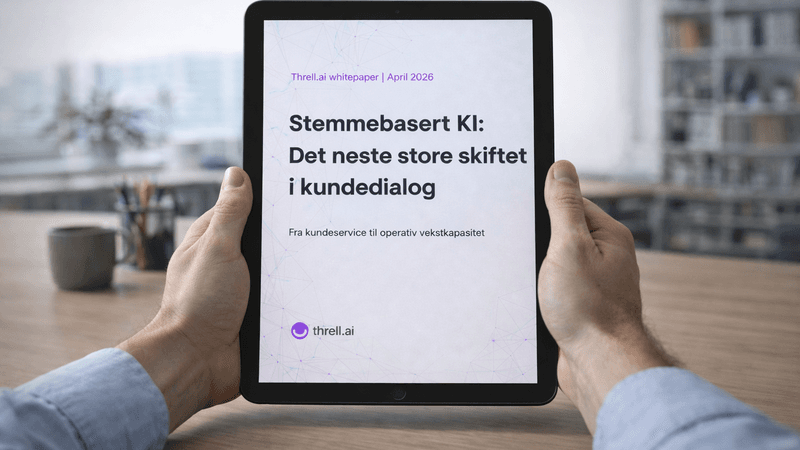
First, it was about direction – why voting and conversation are becoming a new primary interface between humans, systems, and work.
Then about consequence – what happens when technology is actually adopted, and expectations change.
This final article deals with what often comes too late in technology discussions: action, operation, and responsibility.
By 2026, the question is no longer whether voice AI (often referred to as voice-AI) will influence the workday. It already does. The question is which companies choose to face this shift proactively – and which ones will be left behind, optimizing structures that are gradually losing relevance.
When it's no longer about AI – but about operations
Much of the conversation around voice AI is still characterized by fascination with language models, voice quality, and how "human" the technology sounds. That's understandable – but largely a digression.
Currently, when voice AI is used for actual work – first-line contact, customer dialogue, and operational follow-up – the discussion shifts away from intelligence and towards operations.
So the questions become fundamental:
- Does the solution above work over the mobile network, where real conversations actually occur?
- Is the latency low enough for the dialogue to flow naturally, without pauses that break trust?
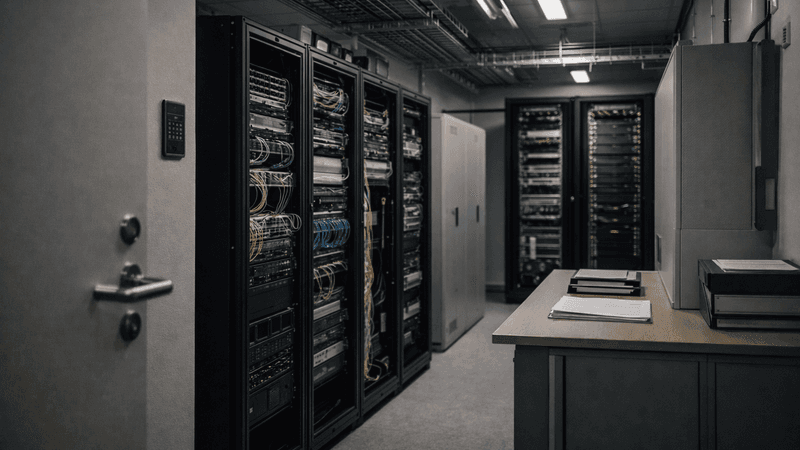
- Is the infrastructure stable, secure, and aligned with Nordic requirements for privacy and data ownership?
- Who is responsible when the technology speaks on behalf of the company's brand?
This is not technical details. It is prerequisites for trust.
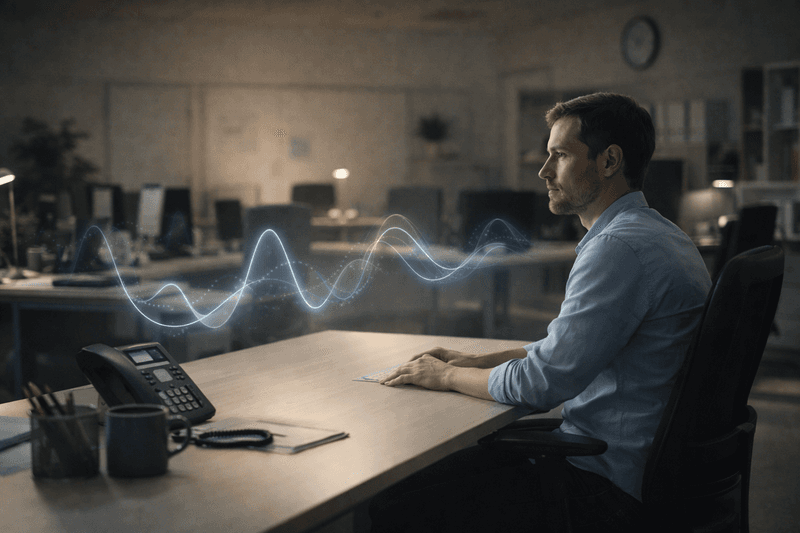
When technology gains a voice, trust becomes something that is built – or broken – in every single conversation.
Why "wait and see" is a trap
Most businesses have learned to approach new technology with caution. They test. Run a pilot. Watch the development.
It's often sensible.
The challenge is that voice AI doesn't just streamline one process. It changes how work is organized, delivered – and expected.
Voice AI is not a new tool on the desktop. It is a scalable form of workforce.
When competitors implement this in actual operations, expectations quickly shift:
- No waiting time will become the minimum requirement
- 24/7 availability will become the norm, not an advantage
In such a landscape, "wait and see" is not neutral.
It is an active choice to let the market define its own relevance.
In other words: if you do not decide for yourself how voting AI should be used in your business, customer expectations will be shaped by those who have already done so.
The economic shift: capacity, not cost-cutting
Stemme-AI is often mentioned in connection with cost reduction. That is a too narrow perspective.
The real economic impact lies in capacity.
Speech AI enables handling larger volumes and being available continuously, without the cost base growing linearly. Frontline work can be scaled digitally, while human capacity is freed for tasks that truly require judgment, relationships, and complexity.
This represents a structural shift in how organizations can grow.
The biggest economic risk therefore does not lie in adopting the technology too early – but in getting stuck in staffing and operational models that do not scale with the market's pace.
In practice, this results in higher cost per inquiry, lower response capacity, and an organization that loses momentum each time demand increases.
Why voting AI in practice requires its own platform
It's relatively simple to connect a language model to a phone system for a demo.
Delivering voice AI in production is something completely different.
Calls must work in real-time, over mobile networks, under varying coverage, with noise, interruptions, and human unpredictability. Delays must be minimized. Routing must be accurate. Responsibility must be clear.
In addition, requirements include:
- local data storage
- compliance with regulations
- security and access control
- traceability and accountability
This is why voice AI practically requires its own comprehensive platform – not just a technological add-on.
Why Threll.ai is built for reality, not the demo
Threll is not a company that experiments with voice.
We are a company that delivers real work in operation.
The platform is designed to:
- operate over the mobile network where real conversations happen
- keep latency low enough for dialogue to feel natural and trustworthy
- use Scandinavian infrastructure with clear ownership of data
- meet security and compliance requirements in Norwegian and Nordic companies
Threll is also platform-agnostic. We are not tied to a single language model or provider, but can use the technology that is best suited at any given time.
For customers, this means higher quality, lower risk, and solutions that withstand technological changes over time.
This is not about flexibility. It's about robustness.
From understanding the shift – to taking action on it
The first article was about direction. The second about consequence. This one is about responsibility.
When technology gains a voice and begins to perform work on behalf of the business, it's no longer enough to be curious. Now, you must be aware – of the architecture, operations, and finances.
Vote-AI is not the future. It is the present.
The question is who uses it to shape the future of work – and who must adapt to others' pace.
Threll.ai is built for organizations that choose the first.