AI phone screening A hundred and fifty applications. Twenty got a call, and the best had already accepted somewhere else.
Threll calls your applicants and runs the first-round interview – same questions, same order, for everyone. Applicants can also call in themselves when it suits them. You read the answers instead of conducting the calls. You set it up yourself in the console in an afternoon – with help from us if you want it.
No lock-in · No setup fee · Set it up yourself, no onboarding call
 150 applicants · 20 called
- Nordic speech, Nordic data storage (EEA)
- Runs on Telenor SIP infrastructure
- The agent says it is an AI assistant
- Live in an afternoon – without switching provider
The applicant who got an offer somewhere else first
A tight candidate market doesn't wait for week three of your process. Whoever calls first gets the conversation. And screening calls are the most repetitive part of the whole hire: the same five questions, a hundred and fifty times, with a note taken if there's time.
The CV doesn't say whether they can start
Notice period, salary expectations, certifications and whether they actually want the job – none of that is in the application.
The recruiter gets to the top twenty
The shortlist is decided by who landed at the top of the inbox, not by who was best suited.
The calls aren't comparable
After thirty interviews in three days you ask things slightly differently. That's when gut feeling starts doing the work.
None of the three answers what you actually need to know: can she start, and does she want to?
Run the numbers with your own figures
It takes just three numbers. How many applicants you have in a month, how many of them should have a screening call, and what one of those calls costs in working time.
You're spending roughly 54,000 kr a month on 90 screening calls. Threll costs 699 kr a month – a handful of screening calls you no longer make yourselves cover it.
We don't know your numbers. But screening calls are among the most expensive minutes in a hire and the least demanding professionally – and that's the whole point. The test week gives you the figure for what they cost, whether or not you pick us afterwards.
Live in a single afternoon
Five steps you do yourself in the console. The agent calls out from the list and takes calls in on your number – you choose whether to use both directions or just one. If you get stuck, we help for free.
Full control of every call
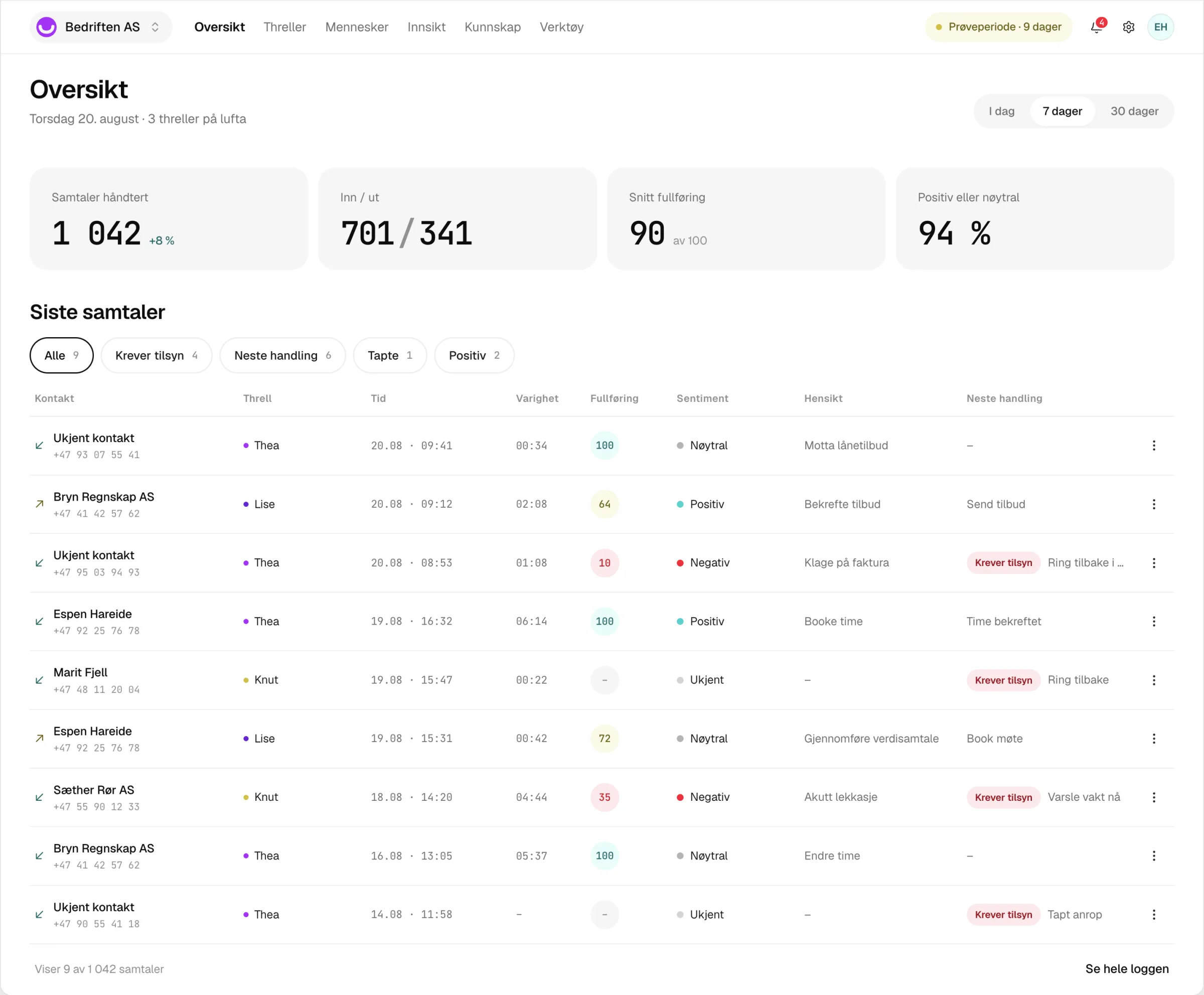
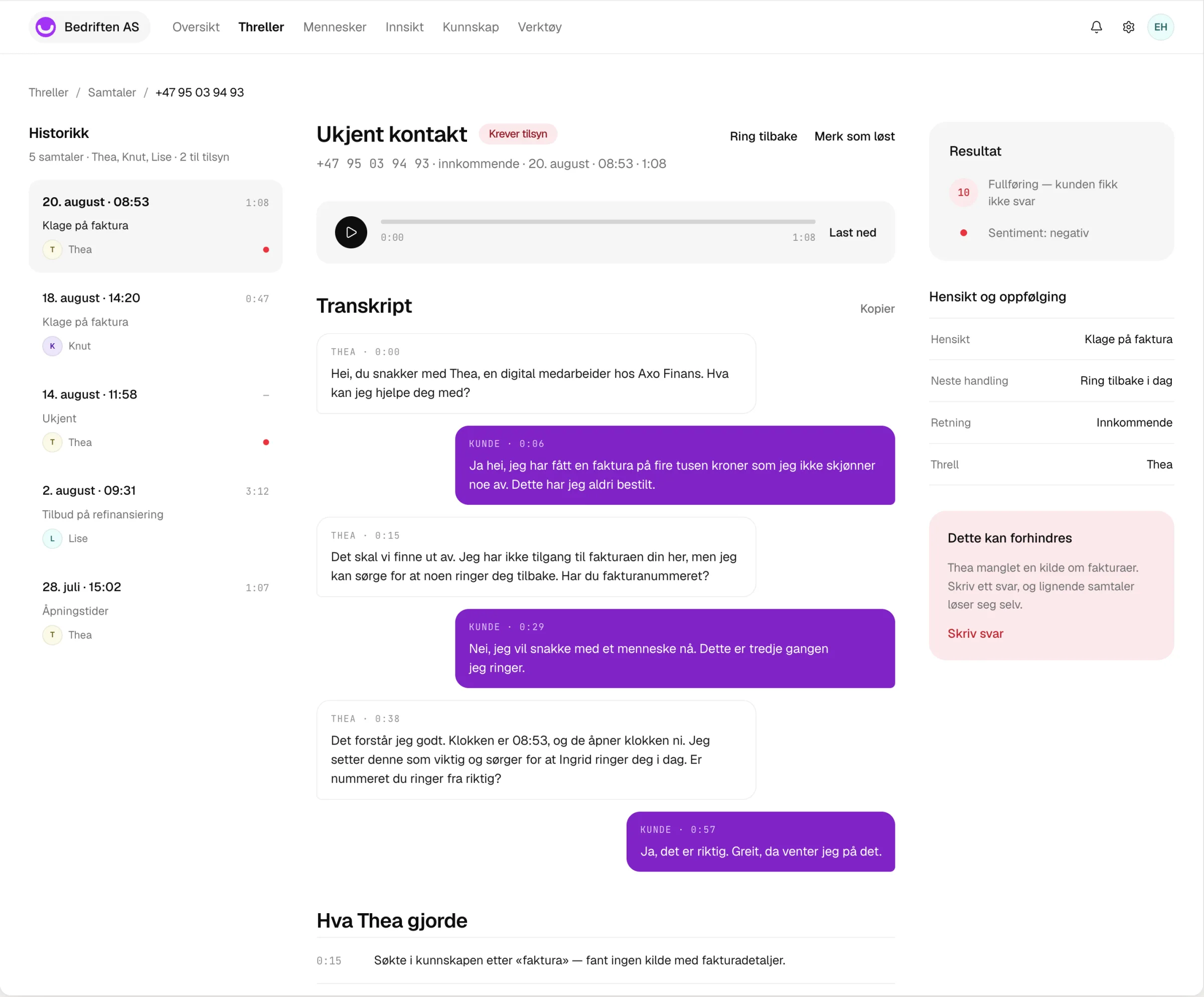
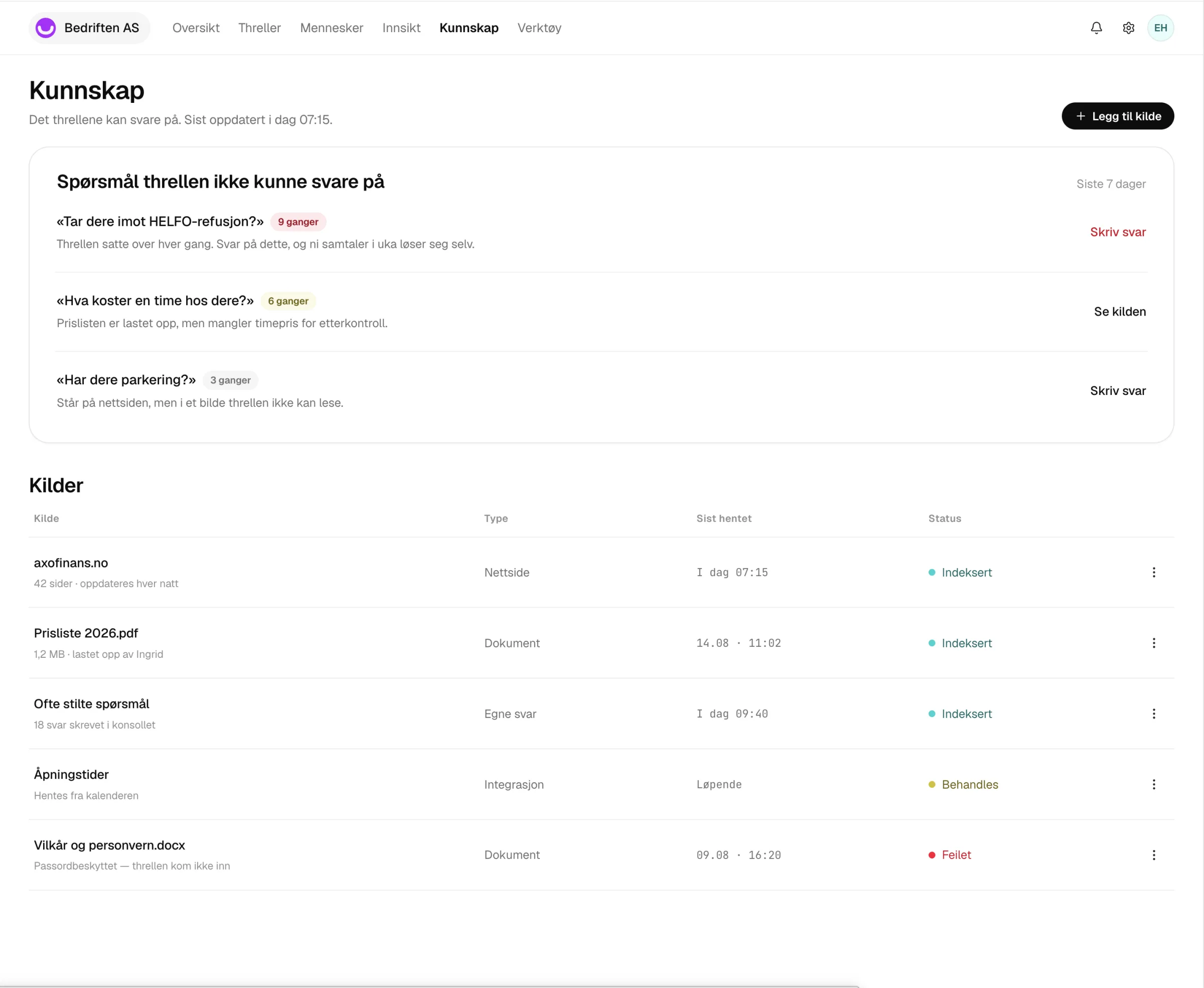
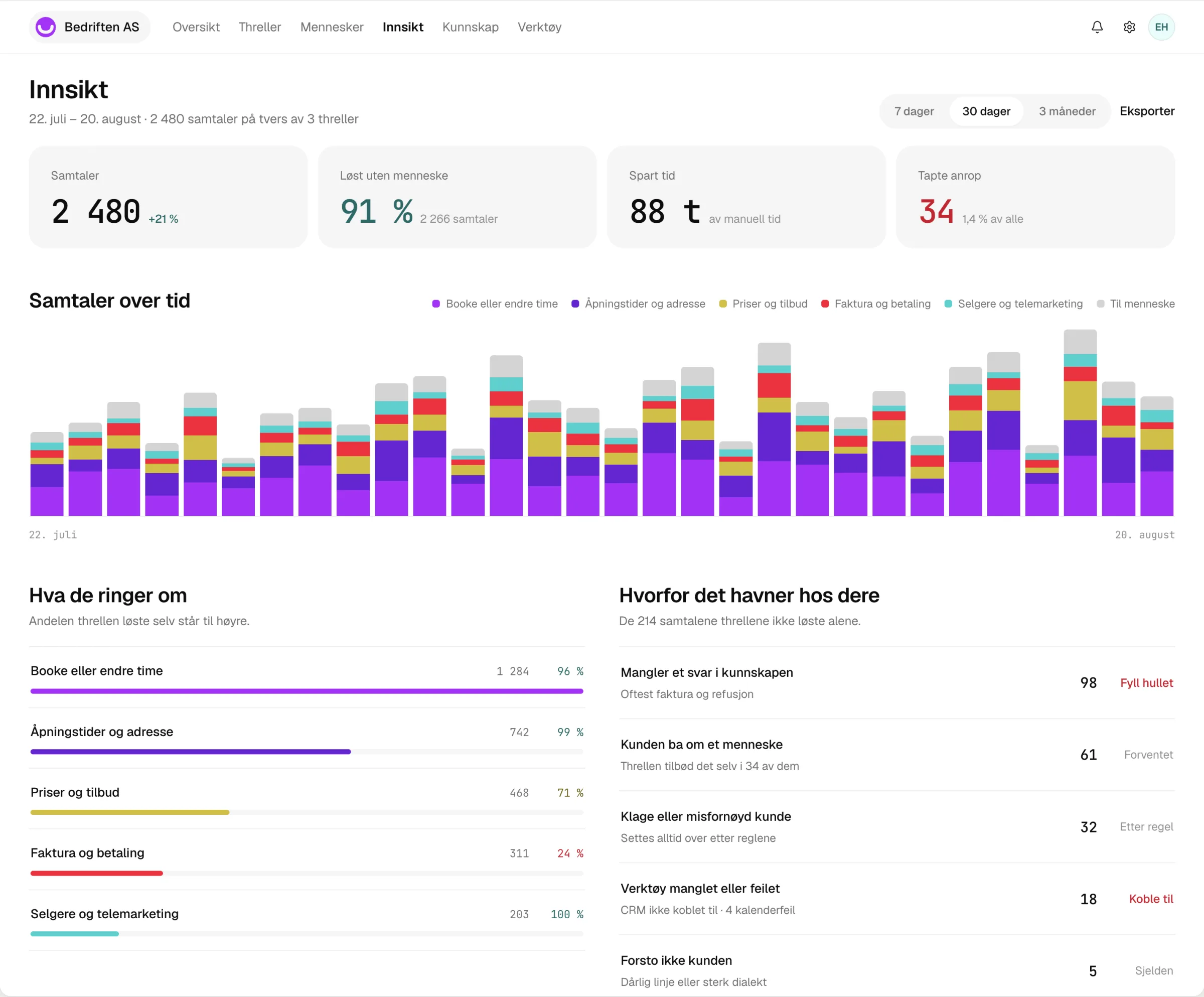
Every call with summary, outcome and recording. You run it all yourself – see what your threll said, and close the gaps as you read.
What the agent actually does
Interviews in real Nordic languages – and 70 more
Natural speech that handles dialect and interruptions. If she applied in her own language but is more confident in English or Polish, the agent switches mid-call. Language shouldn't decide who gets through.
Books the interview with the hiring manager
If the applicant goes through, the agent books the next interview straight into the hiring manager's calendar – while she's still on the line.
Five years in the trade, qualified 2019. Can start 1 October. Salary expectation slightly above current 620. Would rather not travel more than two nights.
Transcript, summary and sentiment
The whole interview verbatim and a five-line summary. You read the conversation instead of writing it up – and the assessment is yours to make.
Checks the requirements before anyone reads the application
You define what the absolute requirements are. Certifications, start date and salary range get settled in the first call, not in interview two.
Calls every applicant, not the top twenty
A hundred and fifty applicants costs the same in time as twenty: none. Everyone gets the same conversation, and the shortlist comes from the answers rather than from the order of the inbox.
Captures the answers comparably
Notice period, salary expectation, availability, certifications, years in the trade. Fixed fields in the same order – so two applicants can genuinely be compared.
Transfers or notifies
If the applicant wants to speak to a person, the agent transfers within opening hours. Otherwise the hiring manager gets the summary by SMS and email.
Interviews many at once
The whole applicant list can be interviewed the same afternoon. The agent takes them in parallel, so round one is done before your competitor has got round to calling.
Authentication with Vipps
The agent can confirm who it's speaking to before the interview – useful when the role requires a background check or professional authorisation and the identity has to hold from the first call.
This is how a first-round interview sounds
A real call from a standard setup. Listen to it – or read it, if you're in the car with someone else.
Hello, this is an AI assistant calling from Nordhaug Bygg about your application for the carpenter role. I ask all applicants the same five questions. Is now a good time?
Yes, that's fine.
Good. First: do you hold a carpentry trade certificate, and how long have you worked in the trade?
Yes, certified in 2019, so that's five years now. Four of them at the same firm.
And if you were offered the role, when could you start at the earliest?
I've got three months' notice, so that would be the first of October.
First of October, noted. What's your salary expectation?
I'm on 620 now, so something above that.
Thank you. That leaves two questions, about certifications and about travel.
Need help getting started?
Book a meeting with us and we will help you get going.
15 minutes · no obligation · pick your own time
Built for the teams with more applicants than they can call
 Staffing and recruitmentThe first call is the volume work, and it's always the bottleneck.
 Trades and constructionCertificates decide it, and that's settled in a minute.
 Health and careShift patterns and professional authorisation have to hold before anyone is invited in.
 RetailSeasonal hiring arrives in batches of a hundred applicants.
 Restaurants and hotelsHigh turnover means round one is run again and again.
 Transport and logisticsLicence class and driving-hours rules are absolute requirements.
 Cleaning and facilitiesMany applicants, many languages, and short notice on start dates.
 Industry and manufacturingWillingness to work shifts is the question that sorts the list fastest.
 Public sectorFormal requirements have to be documented identically for every applicant.
The alternatives, honestly laid out
| Option | Every applicant is called | Requirements checked | Recruiter is shielded | Comparable answers | Cost |
|---|---|---|---|---|---|
| CV screening only | No | Only what's written down | Yes | No | 0 kr, but misses people |
| Form in the application | Those who fill it in | Partly | Yes | Yes, if they answered | Near zero, many drop out |
| Recruiter calls round | The top of the list | Yes | No | Varies by the day | The most expensive minutes |
| Recruitment agency | Yes | Yes | Yes | Yes | Percentage of annual salary |
| Threll | Yes, all of them | Yes, to your requirements | Yes | Yes, word for word | Fixed monthly price |
We don't make the hiring decision. We make sure it's made on the basis of every applicant, not the twenty who were at the top.
A handful of screening calls a month pays for the subscription
A fixed monthly price plus a per-minute rate. On Start you pay for the minutes you use; Pluss and Premium include minutes. Set it up yourself and setup is 0 kr, and monthly billing has no lock-in.
- No included minutes · 4 kr/min
- Urgency judged by your rules
- Summaries by SMS and email
- Dashboard with transcripts
- 0 kr setup, no lock-in
- 500 included minutes · 3.5 kr/min
- Transfer to the right person when urgent
- Booking straight into the calendar
- Weekly report by email
- Priority support
- Outbound follow-up and reminders
- 2,000 included minutes · 3 kr/min
- Several agents and your own call group
- Outbound follow-up and reminders
- Your own data processing agreement and SLA
- A named contact with us
Self-serve setup
Create an account, configure the agent and set up forwarding yourself – in an afternoon. If you need help along the way, it costs nothing.
Create accountDo compare
A human answering service typically charges 25–50 NOK per answered call. A lost customer costs you the whole sale.
Run the numbersWhat your customer hears, and what you need to be able to answer
Five questions you will get – from a customer, a board chair or a procurement officer. The answers are the same on every plan.
The agent says it is an AI assistant
It happens in the first sentence. It is a requirement under the EU AI Act – and it is also what makes customers accept it.
Nordic and European data storage
Call data is processed within the EEA. A data processing agreement is standard, not an add-on.
Telephony on Telenor SIP infrastructure
The same network as the rest of Nordic business telephony. No detour across the public internet.
You own the data
Export or delete whenever you want. You set the retention period yourself.
On-prem and sovereign hosting exist
For those who must have it. Most firms in this segment don't need it – tell us if you do.
Yes, and they're told in the first sentence – the agent says so before it says what it's calling about. What it offers in return is that everyone gets the same conversation: the alternative is being ranked by who the recruiter got round to calling.
The agent conducts the screening call and writes down the answers. It does not rank applicants, give a score or recommend anyone. The assessment and the decision are made by a person, on the basis of the transcript. That line is deliberate: a system that evaluates candidates itself is a different thing entirely, both professionally and in regulation.
Every applicant gets the same questions in the same order, word for word. The whole interview is transcribed, so a decision can be reviewed afterwards – which is hard when the screening happened out loud and the note was taken on the run.
Yes, once you connect the calendar. If the applicant goes through, the interview with the hiring manager is set while she's still on the line. Without a connection the agent proposes times and sends the preferred slot to recruitment.
Call data is processed within the EEA, you set the retention period yourself, and a data processing agreement is standard. Applicants can be given access to their own transcript if you want to offer that.
No. Outbound calls are placed from your own number, and if you want to take calls in as well, a number is forwarded to it. You keep your number, your operator and your setup.
You do it yourself: uploading the applicant list takes ten minutes, and writing the five questions and the absolute requirements typically takes half an hour in the console. If you'd like one of us on a screen share, it costs nothing.
Nothing. You create the account yourself, run a week of first-round interviews on your own applicant list, and have your own figures afterwards.