Language and speech recognition

The hardest thing a Nordic voice agent hears is a number

Norway once changed how an entire country pronounces numbers, because the telephone authority had measured that people were writing phone numbers down wrong. The problem did not go away. It moved to the machine at the other end.

IngridIngrid,
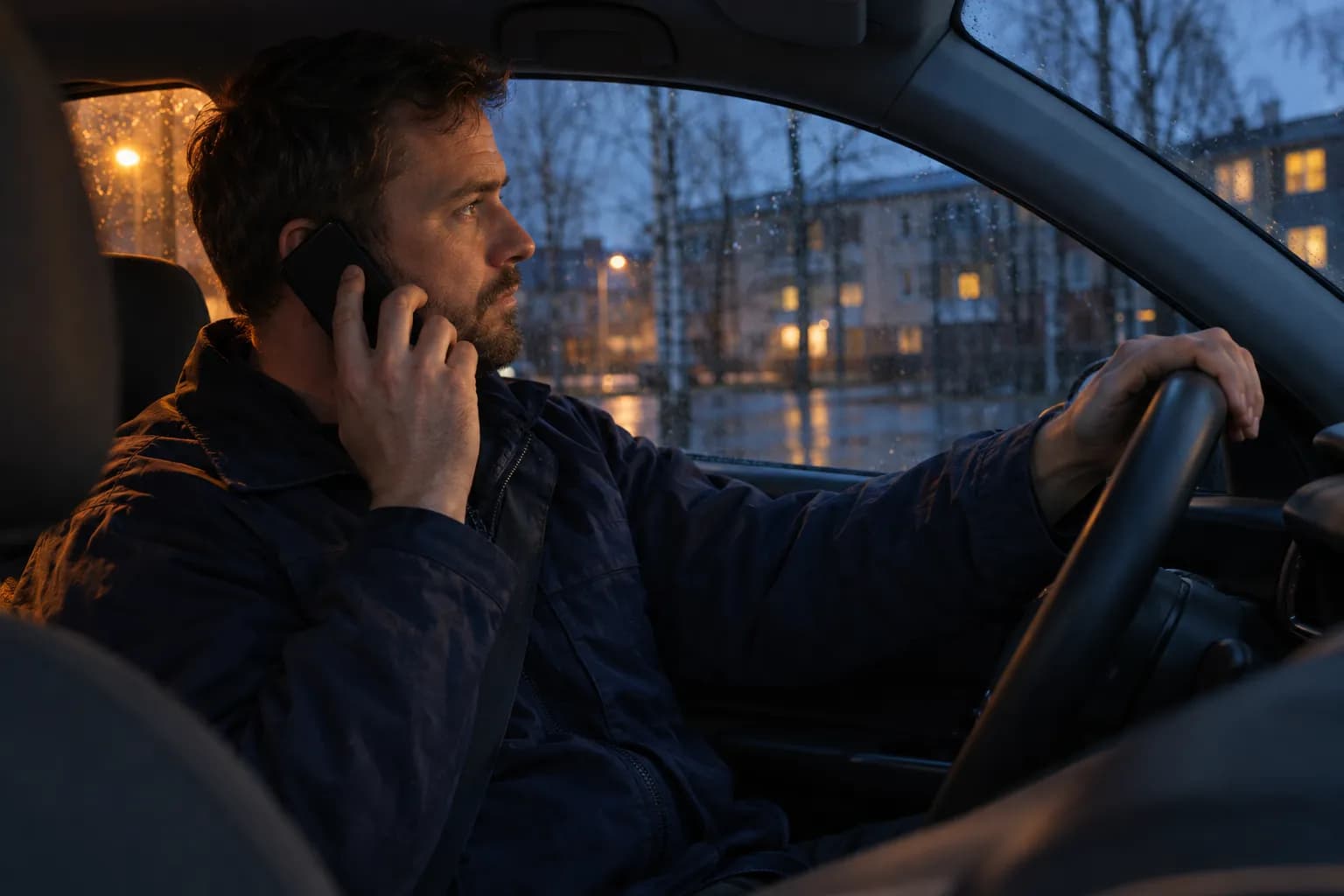
Close-up of a woman in the driver's seat of a parked car reading a number out loud, her phone lying in the dashboard holder and a passenger out of focus in the back seat

Norway has decided by act of parliament how its language should be pronounced exactly once. It happened in 1951, it concerned the number words, and the initiative came from the state telegraph authority.

The reason was practical. Phone numbers in Oslo had been extended from five digits to six, and the telegraph board had measured that people wrote down markedly fewer errors when numbers were spoken in the same order they are written – tjuetre, trettifire, syttiåtte rather than the inverted tre og tyve, fire og tredve, åtte og søtti, which is how Norwegian, like German and Danish, had always done it. Parliament voted unanimously on 22 November 1950, and the new counting system took effect on 1 July 1951.

Seventy-five years later there is no longer a person taking the number down. There is a machine. And it has inherited precisely the problem the telegraph authority set out to remove.

Both counting systems are still in use

The 1951 decision did not abolish the old system. It remains common in everyday speech, particularly among older speakers.

For a voice agent that means seksogtretti and trettiseks are the same number, that syv and sju are the same digit, and that older forms like tyve and tredve turn up in real calls even though they are not standard written Norwegian.

Each of those is easy enough to handle on its own. What makes it hard is that both systems can appear in the same sentence, from the same person, inside the same number. Someone reading out eleven digits will often switch rhythm halfway through without noticing.

A number is not a number. It is a field.

The single most useful thing an agent can know when it hears digits is what the digits are supposed to be.

Norwegian identifiers have fixed lengths, and several of them carry built-in check digits:

Identifier Digits How it is usually read aloud
Postal code 4 One by one, or as a single four-digit number
Phone number 8 In pairs
Company registration number 9 In threes
Bank account number 11 Four, two, five
National identity number 11 Six, then five

If the agent knows it is filling the field "company registration number", it also knows the answer has to be nine digits, and that the last one is a check digit computed from the eight in front of it. At that point the transcription is no longer a guess that has to be accepted. It is a guess that can be rejected. Account numbers and identity numbers carry equivalent checks.

This is a cheap mechanism, and it is cheap precisely because it has nothing to do with audio. The field does the arithmetic, not the ear.

The line strips out what separates the digits

Ordinary telephony carries roughly 300 to 3400 hertz. Everything above that is gone.

That is a sensible trade for speech in general and a poor one for digits. Much of the energy that distinguishes an s-sound from an sh-sound sits above 3400 hertz, which is why over a phone line the Norwegian seks and sju sound less different than they do in a quiet room. In an ordinary sentence this costs nothing, because the rest of the sentence carries the meaning. In a run of eleven digits there is no such help. Every digit has to stand on its own.

It is also why digits are the part of a conversation that degrades most when a system leaves the lab. A demo tells you little about what the agent does for real, and for numbers the gap is at its widest: the demo runs over broadband, on a good microphone, in a quiet room.

The pauses are data

Read a phone number out loud. You group it, with a small pause between each group.

The grouping is not decoration. It is error correction. It tells the listener where each chunk starts and stops, and it is the reason the Norwegian telegraph board got a measurable result at all in 1949.

A conventional voice agent architecture throws that information away. Audio goes to speech recognition, recognition produces a text string, and the text goes on to the language model. The pauses do not survive that step. The model receives 22334455, or 2 2 3 3 4 4 5 5, and has to work out the rest for itself.

It is worth knowing what your vendor actually does here, because it is invisible from the outside and it does not show up in any figure you get reported. High word-level accuracy can sit quite comfortably alongside one in five account numbers being wrong – words are many, and digits are few.

Danish is a different job from Swedish

The same agent is usually sold as "Nordic". On the number side that is three rather different jobs.

Swedish is the easiest. The number words follow written order and the system is plain base ten: femtiotvå is 52, and that is all there is to it.

Danish is the hardest, and it is hard in two ways at once. The order is inverted, the way Norwegian was before 1951: tooghalvfems is 92, units first. And the tens above forty carry the remains of a base-twenty system. Halvtreds comes from halvtredsindstyve – two and a half times twenty – and halvfjerds from halvfjerdsindstyve, three and a half times twenty. A Danish number above fifty is therefore not merely spoken backwards. It also contains an element that does not look like a number at all.

Norwegian sits in between, with two counting systems circulating at once.

The consequence is practical. A model tuned on Swedish numbers and then measured on Swedish numbers will look good and behave badly in Danish – and the errors will collect in exactly the fields that are most expensive to get wrong. It is one of the reasons the languages should be built separately rather than treated as variants of one another.

What actually helps

Three things, in this order.

The agent should know which field it is filling before the customer starts speaking, so that length and check digit can do the work.

It should read the number back in the grouping the customer expects – pairs for a phone number, threes for a company registration number. A read-back in the wrong rhythm gets confirmed almost as often as a correct one, because the customer is listening for digits and not for structure.

And it should be allowed to give up. A number that fails its check digit twice does not deserve a third attempt. That is a point at which the call should go to a human – with the digits the agent did hear passed along with it.

This time the decision cannot come from outside

The 1951 solution was elegant because it was available. You could change how an entire country speaks, because there was one channel and everybody used it.

That way out is gone. Nobody is going to legislate that customers read their account number in groups of four, two and five so the machine has an easier time. The correction has to live in the system.

Threll.ai builds voice agents in Norwegian, Swedish and Danish. An agent that understands your whole sentence but writes down one wrong digit in the account number has not resolved the call. It has only made the error harder to find.

Related Articles

Continue reading more articles